

By Ian Ortega
Yesterday (9th December 2025), I was having dinner with Hajji Omar Mandela (the Chairman of CJ’s) at the Kamwokya branch. I started prompting him with questions. I consider him my Business AI. First question; “what percentage of your sales are the online sales?” He thought hard and gave me a number – about 65%.
We then discussed hubris and companies such as Nokia and Kodak, how these companies had missed the shift. Kodak had the first digital camera, but they just didn’t take it seriously. I said, once you’re successful, you develop these huge blind spots. And you just miss the critical shifts.
I congratulated CJs for not missing the online shift. The fact that they’d gone ahead to build their own infrastructure, set up a call centre, invest in their own delivery bikes, develop their application. And this also ensured that they still maintained end-to-end control of their experience. I repeat it – experience. But they also maintained the new form of capital – cloud capital, all that data about the ordering patterns, how long it takes to serve given areas.
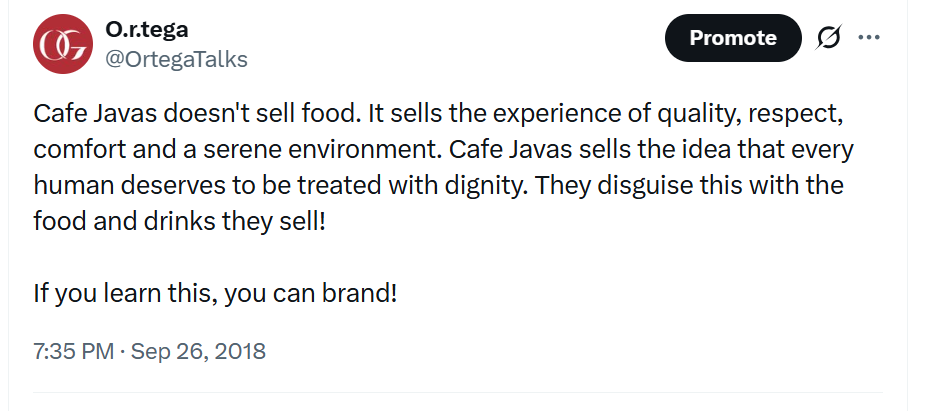
I then moved to my second prompt: “Papa, many people have copied everything about your model, but they just don’t seem to nail it. I mean, they have the same beautiful spaces, same menu items, and even better pricing. What’s the real secret?”
He pointed me to a nearby table. It was a family having a night out. He said, “Ian, look at those sauces. Look at that sandwich, look at that juice, look at those chicken wings. You know it requires its own type of sauce.” Then he realized the talking may not do the explanation. He said, “come, let me show you.”
I followed him to the Kitchen. He pointed to one kitchen equipment, he said, “that one is about 19,000 USD.” But Ian, it’s not just the machine, it’s also the people using it. It’s how you have sourced the products you will use in that machine; it’s the management system and processes running that machine. We walked to other equipment, again, same story. Then I was watching the efficiency and effectiveness with which every order was being processed in the Kitchen. I watched the staff both in back and front office, there was not a single moment to really blink. You must watch every table, that moment when a customer raises their hand.
He told me a scenario where a customer mistakenly used pancake syrup in their tea thinking it’s honey. But staff was at hand to notice that and quickly replace their tea at no extra cost. If you dropped your food while on our premises, that’s getting replaced, everyone knows it. Again, we go back to where it matters – that customer, that experience, and how we can hold it integral at all points, whether in the walk-in or with the bike guy that delivers your order.
And soon I noticed, he comes into the restaurant and performs the same routine. He checks on the customers, notices where constraints are building, he coaches the staff on the job. He watches, he listens, he observes, he guides. There’s no task beneath him in his business. If it means carrying the plates from the Kitchen, he will carry them, if that will ensure the customer is not delayed. You can sense that he enjoys this game of business, passionately, intimately. It’s also something that one can’t just copy, this love to service, that attention to detail, that sensitivity to noticing where things are going wrong.
He can walk in and quickly notice the corner where service is lacking. He just has that art. And he will have the talk with his managers. He never tires of doing these things day in, and day out. Once, he told me; “Ian, I really enjoy my business.”