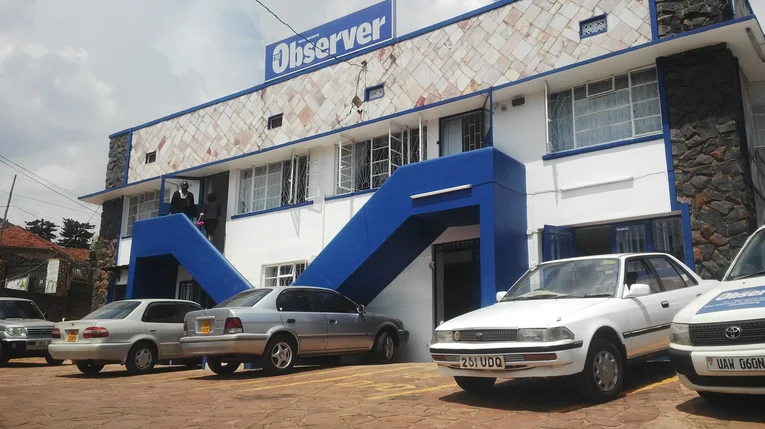
Kamwokya, Kampala, October 2025
The boardroom is tense.
Circulation has fallen below 4,000 weekly copies. Printing invoices require advance payment. Cash flow projections show that, without intervention, working capital will be exhausted within six months. An informal valuation of approximately UGX 1 billion is circulating among potential buyers, primarily as a basis for debt settlement rather than growth capital.
At the center of the discussion is The Observer, once regarded as one of Uganda’s most credible independent newspapers.
The board must decide whether to sell, suspend print and pivot to digital, or attempt a hybrid reinvention with limited capital. The decision will determine whether The Observer becomes a case of institutional decline or strategic renewal.
Founding and Early Momentum, 2004 to 2010
The Observer was founded in March 2004 as The Weekly Observer by a group of journalists who had previously helped build Daily Monitor prior to its acquisition by Nation Media Group.
Among the founders was Kevin Aliro, a former teacher and respected editor who believed Uganda needed a principled, non partisan publication grounded in intellectual rigor. The paper positioned itself as “Your Paper of Record,” emphasizing credibility, investigative depth, and gender sensitive reporting.
Within a year of launch, Aliro died after a short illness. The organization was still fragile and undercapitalized. Leadership transitioned to James Tumusiime and other senior editors, who inherited both an editorial vision and a financial challenge.
Between 2006 and 2010, The Observer experienced significant growth. Weekly circulation rose to nearly 20,000 copies at its peak. The publication expanded into a tri weekly schedule. Advertising revenues increased steadily, particularly during election cycles. The newspaper earned recognition for investigative journalism and was widely regarded as independent in a politically sensitive media environment.
By the end of the decade, The Observer had established brand credibility among policymakers, civil society leaders, academics, and corporate executives.
Structural Weaknesses Beneath Growth
Despite strong editorial momentum, the organization did not institutionalize managerial and financial systems at the same pace.
The management team was composed primarily of journalists who were learning executive management responsibilities on the job. Governance structures evolved slowly. Internal controls improved gradually but remained vulnerable. Fraud incidents, while not existential, exposed oversight gaps.
Most critically, capital allocation decisions during high revenue years did not prioritize long term asset accumulation. The company did not acquire its office premises. It did not invest in a printing press. It did not meaningfully build digital infrastructure while print margins remained positive.
Profits were largely absorbed by operating costs rather than reinvested in strategic capacity.
As long as circulation and advertising remained strong, these weaknesses were manageable. Once industry conditions shifted, they became constraints.
Industry Disruption, 2010 to 2020
Over the following decade, Uganda’s media landscape transformed.
Large, diversified players such as Vision Group operated across print, radio, television, and digital platforms, allowing them to cross subsidize losses. Next Media invested heavily in broadcast and digital expansion. Nation Media Group leveraged regional scale.
At the same time, smartphone penetration increased rapidly. Social media platforms including TikTok, YouTube, Instagram, and X fundamentally altered news distribution.
Barriers to entry collapsed. Individual content creators built audiences comparable to small media houses. For example, entertainment commentator Kasuku developed a large following with minimal fixed costs.
Advertising budgets migrated toward digital targeting and social media sponsorships. Print advertising began a structural decline.
The Observer launched a website and experimented with digital content, but digital monetization remained limited. The organization continued to rely heavily on print circulation and advertising revenue.
Between 2015 and 2023, circulation declined steadily from nearly 20,000 copies to below 5,000. Fixed costs, particularly printing and distribution, became increasingly burdensome relative to revenue.
Governance and Leadership Strain
As revenues tightened, operational pressure intensified.
The CEO carried dual responsibilities, managing editorial standards while addressing creditor negotiations and payroll challenges. Reports of leadership fatigue and burnout circulated internally. Board meetings became increasingly focused on liquidity management rather than long term strategy.
Organizational morale weakened. Younger journalists advocated for aggressive digital transformation. Senior editors feared that abandoning print would erode the brand’s identity and credibility.
The board recognized that governance reform might be necessary before any investor would commit new capital.
The Current Decision Point, 2025
In 2025, The Observer faces three principal options.
Option 1, Immediate Sale
An outright sale could stabilize liabilities and preserve some shareholder value. However, media valuations are depressed across the sector. Potential buyers question whether a standalone print newspaper can generate sustainable returns in Uganda’s evolving media economy.
There is also concern that a sale could compromise editorial independence, historically central to the brand.
Option 2, Full Digital Pivot
This strategy would suspend or significantly reduce print operations and reallocate resources to:
- Video first journalism
- Subscription based investigative reporting
- Diaspora targeted digital content
- Events and policy forums
The objective would be to reposition The Observer as a premium digital influence platform rather than a mass print newspaper.
However, this approach requires capital investment in technology, talent, and marketing. Competing with diversified incumbents would require both strategic clarity and financial runway. Without external funding, execution risk is high.
Option 3, Premium Niche Repositioning
A third path would reposition The Observer as a high trust investigative and policy publication serving corporate leaders, diplomats, civil society, and diaspora investors.
Revenue would derive from:
- Paid subscriptions and memberships
- Sponsored policy events
- Data driven reports
- Targeted advertising
This model prioritizes depth and influence over circulation volume. The central question is whether Uganda’s market size and income levels can sustain such a premium strategy at scale.
The Core Strategic Asset, Trust
For over two decades, The Observer built a reputation for independence in a politically complex environment. Its journalists faced legal pressure. Offices experienced break ins. The publication launched investigative initiatives designed to reduce commercial interference.
That credibility remains intangible but significant.
The board’s debate now centers on whether this accumulated trust can be converted into a sustainable digital revenue model.
Trust is difficult to measure on a balance sheet, yet it may represent the organization’s most defensible competitive advantage.
Issues for Future Media Leaders
The Observer’s situation raises broader questions relevant to emerging market media companies:
- How should founder led media organizations institutionalize governance before crisis emerges?
- When should legacy cash flows be reinvested into disruptive technologies?
- Can credibility based brands monetize effectively in low to middle income digital markets?
- What leadership capabilities are required to transition from print management to digital platform strategy?
- At what point does preservation of legacy become value destructive?
As the board prepares to vote on its strategic direction, the presses continue to run. Yet the real decision is not about ink and paper. It is about whether an institution built for the print era can redesign itself for a platform driven future.
The outcome will shape not only The Observer’s trajectory, but also the contours of independent journalism in Uganda’s next decade.