
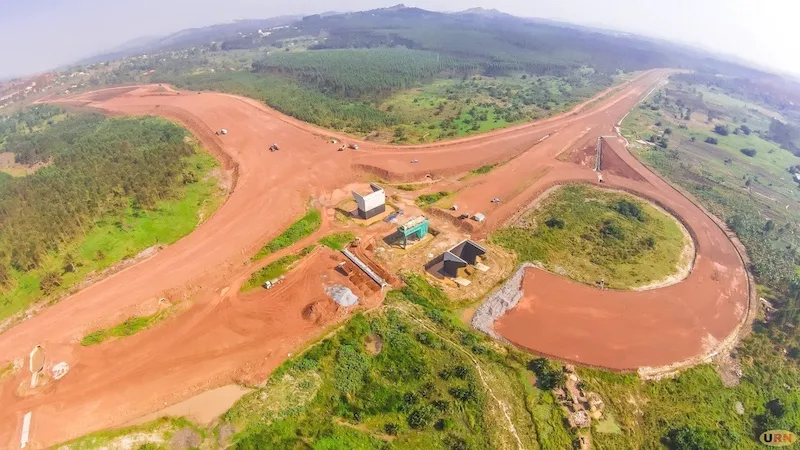
Executive Summary
The Busega–Mpigi Expressway offers an unusually valuable case study for understanding how major infrastructure projects can become compromised long before construction visibly fails.
The project did not begin as a construction problem. Its origins lie in a 2010 feasibility and detailed engineering design contract for the wider Kibuye–Busega–Mpigi corridor. Over the following years, the project moved through changes in financing strategy, design development, institutional responsibilities, road alignment, land acquisition, procurement and ultimately construction.
The critical issue was not that change occurred. Change is inevitable in infrastructure.
The deeper problem was that major commitments were made while several fundamental elements of the project were still evolving.
The project chronology shows that in January 2016 the Head of Design at UNRA requested that civil works procurement be held until the detailed design and engineering supervision consultant had completed the design and bidding documents. Despite this warning, procurement subsequently progressed and a civil works contract was eventually signed in June 2019 for approximately UGX 547.5 billion.
The project then experienced further alignment and design changes. In 2017, land acquisition was interrupted while the revised alignment was being confirmed. In 2019, after the contractor had been appointed, the contractor requested a revised layout to support mobilization. In 2021, the design review process was still producing amendments relating to geotechnical works, bridges and structures, followed by a final design update.
By September 2022, the Engineer was evaluating a contractor variation proposal valued at approximately UGX 1.143 trillion.
The Auditor General subsequently reported that the project had reached approximately 40.86% physical progress while the original civil works funding had effectively been exhausted, and that the estimated project cost had risen to approximately UGX 1.35 trillion. (Office of the Auditor General)
The case therefore raises a fundamental project-management question:
What happens when a project enters procurement and construction before its scope, design, land, cost and financing have been sufficiently aligned?
The answer is a familiar infrastructure failure cycle:
Unresolved design → scope change → land disruption → construction uncertainty → variations → claims → funding gap → delay → additional financing → increased public exposure.
This case is designed not to establish individual culpability. Public investigations into the project remain matters of due process. Instead, it examines the systems, decisions, warning signals and management failures that project managers should learn to recognize and prevent.
1. The Project
The Busega–Mpigi Expressway was conceived as part of Uganda’s broader effort to improve strategic road infrastructure and increase capacity along important transport corridors.
The original feasibility and engineering work covered the Kibuye–Busega–Mpigi corridor.
In May 2010, UNRA contracted H.P. Gauff Ingenieure GmbH & Co. KG to undertake the feasibility study and detailed engineering design for the Capacity Improvement of Kibuye–Busega–Mpigi Road, approximately 32 km.
The later project configuration included a 23.7 km Busega–Mpigi section.
The 2015 design described:
- an 8.7 km Kibuye–Busega section;
- a 23.7 km Busega–Mpigi section;
- grade-separated interchanges;
- and an interchange at Lungala in the Busega–Mpigi section.
The project subsequently became embedded in a much larger infrastructure-financing and PPP discussion involving the Government of Uganda, UNRA, the African Development Bank and IFC.
That institutional complexity would later become important.
2. A Project with Many Owners
The project had several institutional and professional actors.
Within UNRA, two directorates played particularly important roles.
Directorate of Network Planning and Engineering — DNPE
DNPE acted as the central technical/design authority.
Its responsibilities included:
- technical expertise;
- design;
- preparation of Requests for Proposals;
- preparation of Terms of Reference;
- technical support to project implementation.
Directorate of Roads and Bridges Development — DRBE
DRBE was responsible for:
- procurement;
- project management;
- day-to-day operations;
- contractor management;
- consultant management;
- land acquisition;
- resettlement action plans;
- project correspondence.
The two directorates reported through their respective structures to the Executive Director of UNRA.
Other key parties included:
- Government;
- the UNRA Executive Director/Accounting Officer;
- Contracts Committee;
- Gauff;
- the design review and construction supervision consultant;
- AfDB;
- IFC;
- the civil works contractor.
The project was administered under FIDIC arrangements and the contractor was engaged under an admeasurement contract.
This created a classic challenge in large infrastructure projects:
Many organizations can own pieces of the project, while nobody necessarily owns the entire system.
3. The Long Gestation
The project had a remarkably long period between conception and construction.
| Date | Event |
|---|---|
| May 2010 | Gauff appointed for feasibility study and detailed engineering design |
| 2012 | Government explores PPP/non-traditional financing |
| 2013 | UNRA confirms feasibility and detailed design status to IFC |
| 2014 | IFC transaction advisory agreement develops |
| July 2015 | Gauff submits feasibility study and detailed engineering design |
| 2016 | Design, SGR harmonization and financing issues emerge |
| 2017 | Alignment changes and land-acquisition disruption |
| 2018 | Design/supervision consultancy awarded |
| 2019 | Civil works contract signed |
| 2021 | Design review and final design update |
| 2022 | Major variation proposal evaluated |
| 2023 | UNRA Special Board reviews the realignment issue |
| 2024 | Original civil works funding exhausted while project remains incomplete |
| 2025–26 | Additional financing and intensified parliamentary/investigative scrutiny |
The lesson is not that a long gestation period is inherently bad.
Large infrastructure projects often take many years.
The lesson is:
Long gestation must produce increasing certainty—not simply increasing age.
A project can be ten years old and still not be construction-ready.
4. The First Warning Signal
The most important event in the chronology may be one that initially looks mundane.
On 5 January 2016, the Head of Design wrote to the Land Acquisition and Procurement functions requesting that civil works procurement be held until the Detailed Design and Engineering Supervision Consultant completed the design and bidding documents.
This was an internal technical warning.
It mattered because it identified the fundamental risk:
The project was not yet sufficiently defined for civil works procurement.
Yet the project continued through procurement processes.
The management question
When an organization has an internal technical warning saying:
“Do not proceed yet.”
but the organization proceeds anyway, the issue becomes larger than engineering.
It becomes a governance question.
Who had authority to override the warning?
What evidence justified proceeding?
Was the risk formally accepted?
Was the decision documented?
What assumptions were made about the remaining design work?
Those questions should be answered on every major public infrastructure project.
5. The SGR Interface
In 2016, another major infrastructure interface emerged.
The Ministry of Finance asked whether the designs for Kibuye–Busega–Mpigi, Kampala–Entebbe Expressway and the Standard Gauge Railway had been harmonized.
UNRA subsequently indicated that SGR harmonization would create additional design costs, particularly around the Kibuye–Busega sections.
This illustrates a fundamental infrastructure principle:
Infrastructure projects do not exist independently of other infrastructure projects.
A road alignment interacts with:
- rail;
- utilities;
- drainage;
- settlements;
- existing roads;
- future development;
- land;
- environmental constraints.
These interfaces must be identified before the design is frozen.
6. The Alignment Problem
The alignment subsequently changed.
In September 2017, the land acquisition function requested confirmation of the realignment for Section 2.
In October 2017, DNPE shared an updated layout and right-of-way coordinates.
The land acquisition process had already been interrupted at the stakeholder engagement and sensitization stage and required the final realigned design before it could resume.
This is where one technical decision began to generate consequences across several project functions.
Design change
↓
New right-of-way
↓
New affected persons
↓
Revised RAP
↓
Additional compensation
↓
Delayed access
↓
Construction disruption
The project manager’s job is to see this chain before it happens.
7. The Land Acquisition Problem
Land acquisition is often treated as a parallel administrative activity.
That is a mistake.
For a road project, land is effectively a construction input.
No right-of-way means no construction.
The chronology shows that by May 2018 the original Resettlement Action Plan, prepared in July 2015, had already been overtaken by time. A request was made for it to be updated and for external support because the responsible team was heavily occupied.
This demonstrates another important lesson:
A design change can invalidate a social and land-acquisition baseline just as it can invalidate a quantity estimate.
The three baselines must therefore move together:
Design baseline
Land baseline
Cost baseline
8. The Contractor Enters the Picture
The civil works contract was eventually signed on 18 June 2019.
The contractor was China Civil Engineering Construction Corporation in joint venture with China Railway 19th Bureau Group.
Contract value:
UGX 547.543 billion.
This should have represented a major transition:
Design phase → Construction phase
But the chronology suggests that the transition was not as clean as it should have been.
At the inaugural meeting on 10 July 2019, the contractor requested a revised layout for mobilization planning.
UNRA subsequently shared the revised road alignment with the contractor.
This is an important red flag.
The contractor had been awarded the project.
Mobilization was beginning.
Yet the alignment was still moving.
9. The Design Review Continues
In 2021, the project was still dealing with significant technical issues.
The Design Review Report generated requests for amendments relating to:
- geotechnical works;
- bridges;
- structures.
On 8 October 2021, UNRA issued a no-objection to the final design update and authorized the consultant to seek the contractor’s proposal for varied works.
The chronology therefore produces a critical observation:
The civil works contract was signed in 2019, but a major final design update was still being approved in 2021.
This does not automatically mean the contract was improperly awarded.
Design development can continue during construction.
But the scale and nature of changes matter.
The central question becomes:
Were these normal construction-stage refinements, or were they corrections to fundamental project-definition deficiencies?
That distinction is critical.
10. The Variation
The consequences became visible in September 2022.
The Engineer evaluated the contractor’s variation proposal at approximately:
UGX 1.143 trillion.
Compare that with the original contract:
Original contract: UGX 547.5 billion
Variation proposal: UGX 1.143 trillion
The variation proposal alone was more than twice the original contract value.
This is no longer a normal project variation.
It should trigger a strategic review.
The project manager should ask:
- What changed?
- Why did it change?
- When should the change have been known?
- Who caused the change?
- Who approved the change?
- Who pays for the change?
- Does the project still have the same business case?
- Should the contract continue?
- Should the project be re-baselined?
- Should the expanded scope be separately procured?
11. Cost Explosion
The Auditor General subsequently reported that the project cost had risen substantially from the original contract value, with the revised project estimate reaching approximately UGX 1.35 trillion. (Office of the Auditor General)
The increase is approximately:
UGX 1.35 trillion − UGX 547.5 billion = UGX 802.5 billion
or roughly:
147% above the original contract value.
This is the number that attracts public attention.
But the number itself is not the root cause.
The project manager should instead ask:
What decisions created the UGX 802.5 billion difference?
A useful decomposition is:
Design-driven
- alignment changes;
- structures;
- geotechnical requirements;
- revised quantities.
Scope-driven
- additional interchanges;
- service roads;
- link roads;
- tolling infrastructure;
- other additions.
Land-driven
- additional right-of-way;
- compensation;
- resettlement.
Time-driven
- prolongation;
- escalation;
- contractor claims;
- financing costs.
External
- macroeconomic changes;
- extraordinary events.
Until the increase is decomposed into these causal categories, the phrase “cost escalation” is too vague to be useful.
12. The Funding Crisis
The Auditor General reported that the original civil works funding was exhausted while the project remained substantially incomplete. Physical progress was approximately 40.86%. (Office of the Auditor General)
This creates one of the most dangerous states in infrastructure delivery:
The project has consumed its financial envelope but still has a large amount of physical work remaining.
At that point, management has only a few options:
- stop;
- reduce scope;
- find additional financing;
- restructure the contract;
- renegotiate;
- or some combination of the above.
But none of these options are cheap.
The earlier the funding gap is identified, the more options management has.
The later it is identified, the more expensive those options become.
13. Delay Becomes a Financial Problem
A common mistake is to treat schedule as separate from cost.
On a major construction project:
Time is money.
If a project is delayed, the consequences can include:
- contractor prolongation costs;
- claims;
- price escalation;
- consultant extensions;
- financing costs;
- land holding costs;
- inflation;
- lost economic benefits;
- additional supervision;
- political pressure.
Parliament later reported that contractor claims had reached approximately UGX 578 billion before negotiations reportedly reduced them to approximately UGX 78 billion. (Parliament of Uganda)
Whether each claim is valid is a separate contractual question.
The management lesson is simpler:
Poor upstream project definition can become a downstream contractor claim.
14. The Governance Dimension
The project had multiple institutions and professional disciplines.
That is normal for a major road.
The danger lies in the interfaces.
Consider the chain:
DNPE
owns design.
DRBE
owns project and contract management.
Land acquisition
owns right-of-way.
Procurement
owns tender processes.
Finance
owns funding.
Consultant
reviews, certifies and determines.
Contractor
executes.
Each may perform its own role correctly while the project as a whole performs badly.
This is the classic silo optimization problem.
A project manager therefore needs a role that transcends the organizational chart:
Someone must own the integrated project outcome.
15. The Three Root Causes
The entire case can be reduced to three systemic failures.
Failure 1: Construction commitment preceded project maturity
The project moved toward civil works procurement despite technical concerns about design completeness.
The result was uncertainty entering the contract.
Failure 2: Scope and alignment continued to evolve after commitment
The project experienced alignment changes, design review, additional requirements and major variations after the civil works contract had been awarded.
The result was cost and schedule instability.
Failure 3: The project lacked sufficiently integrated governance
Design, land, procurement, financing and construction were managed through different institutional structures.
The result was that problems at one interface propagated into other parts of the project.
Together:
Premature commitment + uncontrolled change + fragmented governance = project failure.
16. The Critical Decision Points
A useful way to study the case is to identify the moments when management still had an opportunity to change the trajectory.
Decision Point 1 — 2016
Technical leadership recommends holding civil works procurement.
Question: Should management proceed?
Decision Point 2 — 2016
SGR harmonization creates design implications.
Question: Should the project design be frozen before the interface is resolved?
Decision Point 3 — 2017
Alignment changes affect land acquisition.
Question: Should the project baseline be reset?
Decision Point 4 — 2018
The RAP is already outdated.
Question: Is the project truly construction-ready?
Decision Point 5 — 2019
Contractor requests revised layout after award.
Question: Should mobilization proceed?
Decision Point 6 — 2021
Major design review amendments continue.
Question: Is this design refinement or project redefinition?
Decision Point 7 — 2022
Variation proposal reaches approximately UGX 1.143 trillion.
Question: Is this still the same project?
Decision Point 8 — 2024
Original funding is exhausted with less than half the physical works complete.
Question: What is the least-cost recovery strategy?
These are the decisions future project managers should learn to recognize.
17. The Counterfactual: What Should Have Happened?
Imagine the project manager had enforced a strict readiness gate in 2016.
The rule:
No civil works procurement until design, alignment, land and financing are sufficiently mature.
The project would have paused.
That would have looked like failure.
It would actually have been good project management.
During the pause, management could have:
- finalized the design;
- harmonized the road with the SGR;
- finalized the alignment;
- updated the RAP;
- completed right-of-way planning;
- updated quantities;
- updated the cost estimate;
- secured financing;
- revalidated the business case;
- then procured construction.
The project might have started later.
But it would have had a much higher probability of finishing within a credible cost and schedule envelope.
This is one of the hardest lessons in project management:
A controlled delay before commitment is often cheaper than an uncontrolled delay after commitment.
18. The Five Baselines
Before construction, every major infrastructure project should have five synchronized baselines.
1. Scope baseline
Exactly what are we building?
2. Design baseline
Exactly how are we building it?
3. Land baseline
Exactly where can we build it?
4. Cost baseline
Exactly how much will it cost?
5. Funding baseline
Exactly where will the money come from?
These five must be connected.
A design change affects land.
Land affects cost.
Cost affects funding.
Funding affects schedule.
Schedule affects contractor claims.
Therefore:
Scope, design, land, cost and funding are one system.
19. The Future Infrastructure Project Gate
A robust project should move through seven gates.
GATE 1 — Strategic Case
Prove:
- strategic need;
- traffic demand;
- economic case;
- preferred corridor.
GATE 2 — Concept Selection
Freeze:
- preferred alignment;
- major interfaces;
- environmental/social strategy;
- financing model.
GATE 3 — Design Freeze
Require:
- detailed engineering;
- geotechnical investigations;
- structures;
- drainage;
- quantities;
- bills of quantities;
- technical specifications.
GATE 4 — Land Readiness
Require:
- approved RAP;
- compensation plan;
- right-of-way strategy;
- critical land availability.
GATE 5 — Financial Close
Require:
- approved cost;
- contingency;
- escalation allowance;
- committed financing;
- cash-flow plan.
GATE 6 — Procurement
Only now:
Tender → evaluate → award.
GATE 7 — Construction Readiness
Before notice to proceed:
Design + Land + Funding + Contractor + Supervision + Interfaces = READY
20. The Change-Control Rule
Change is inevitable.
Uncontrolled change is not.
Every major change should answer six questions:
What changed?
Why did it change?
When should it have been known?
What does it cost?
Who caused it?
How will it be funded?
A project should establish escalation thresholds.
For example:
| Change | Required response |
|---|---|
| <5% cost impact | Project manager |
| 5–10% | Project steering committee |
| 10–20% | Independent technical/commercial review |
| >20% | Executive re-baseline |
| >30% | Independent review of whether the project/contract remains viable |
The exact thresholds can differ by project.
The principle cannot:
A change that materially changes the project must trigger a project-level decision—not merely a contract-level approval.
21. The Project Dashboard
A future project director should be able to see the entire project on one page.
| Area | Critical question |
|---|---|
| Scope | Is the scope frozen? |
| Design | Are IFC drawings complete? |
| Land | Is the right-of-way available? |
| Cost | What is the latest forecast at completion? |
| Funding | Is funding sufficient for that forecast? |
| Schedule | Are we ahead or behind? |
| Contractor | Is productivity adequate? |
| Variations | How much scope has changed? |
| Claims | What is our exposure? |
| Quality | What is the defect/NCR trend? |
| Risk | What are the top five quantified risks? |
| Decisions | Which management decisions are overdue? |
The most important number should be:
Estimate at Completion versus Approved Budget
If that number begins to diverge materially, management must act immediately.
22. The Investigation Framework
For investigators, the project should be reconstructed through a decision chain, not merely a chronology.
For every major event ask:
1. What was known?
2. When was it known?
3. Who knew?
4. Who had authority?
5. What decision was made?
6. What alternative decisions existed?
7. What was the consequence?
8. Who bore the cost?
This converts the investigation from:
“The project cost too much.”
into:
“Decision X was made with information Y available, resulting in consequence Z.”
That is much more powerful.
23. Ten Questions for the Investigation
- Why was civil works procurement allowed to proceed when the Head of Design had requested that it be held pending completion of design and bidding documents?
- What exactly changed between the original design and the final design?
- Why was the alignment changed, and what engineering, economic and social analysis supported that decision?
- Why was land acquisition allowed to progress before the alignment was sufficiently stable?
- Why did the contractor request a revised layout after contract award?
- Which elements of the eventual variation were unforeseeable, and which should reasonably have been included in the original design?
- Why did the project’s cost move from approximately UGX 547.5 billion to approximately UGX 1.3–1.35 trillion?
- How much of the increase was attributable to design, scope, land, inflation, delay and contractor claims respectively?
- Who owned the integrated project baseline across DNPE, DRBE, land, procurement, finance and the consultants?
- At what point should management have stopped, re-baselined or re-procured the project rather than continuing with variations?
24. The Deeper Lesson for Project Managers
The Busega–Mpigi case demonstrates a fundamental truth about infrastructure:
Projects rarely fail at the point where failure becomes visible.
The visible failure may be:
- a delayed road;
- a cost overrun;
- a contractor claim;
- an incomplete interchange;
- exhausted financing.
But the causal failure may have occurred years earlier.
Perhaps when the design was not mature.
Perhaps when an alignment was changed.
Perhaps when land acquisition was allowed to lag.
Perhaps when procurement proceeded despite a warning.
Perhaps when a variation was treated as a contract issue rather than a project-definition issue.
The project manager’s greatest responsibility is therefore not to manage the construction site.
It is to protect the integrity of the project baseline.
25. The One-Sentence Lesson
If this case were reduced to one sentence for a future project manager, it would be:
Never commit a project to construction until scope, design, land, cost, financing and interfaces are sufficiently mature—and never allow a major post-award change to masquerade as a routine variation.
26. Closing Reflection
Busega–Mpigi should not be remembered simply as a road that took too long or cost too much.
It should be studied as a lesson in how project risk compounds.
At the beginning, uncertainty is cheap.
During design, uncertainty is manageable.
During procurement, uncertainty becomes expensive.
During construction, uncertainty becomes a claim.
After funding is exhausted, uncertainty becomes a crisis.
And once the project enters public-investigation territory, uncertainty becomes an accountability problem.
The project manager’s job is therefore to move uncertainty to the left:
Find it early. Quantify it early. Resolve it early.
The strongest project managers are not those who rescue failing projects heroically.
They are those who recognize, early enough, that the project is not ready to proceed—and have the discipline and authority to stop it until it is.
Busega–Mpigi is therefore ultimately a case about one question:
Did the project become committed before it became ready?
That is the question every future infrastructure project manager should learn to ask.