
By Ian Ortega
There is a concept known as the theory of constraints. Many people are familiar with it, but few apply it in real life, except perhaps those who have worked with assembly lines or supply chains. This theory becomes useful when examining Uganda Electricity Distribution Company Limited, UEDCL, as it takes over from UMEME. Just weeks into the takeover, Uganda has experienced a wave of power blackouts.
UEDCL’s explanation is that UMEME failed to invest adequately in the grid, leaving behind a fractured distribution infrastructure. While many argue that Uganda’s distribution challenges began with the UEDCL takeover, I take a different view. The problem already existed. The takeover merely exposed it more clearly by multiplying interests and, in doing so, magnifying the weaknesses.
At its core, this is a last mile problem. UMEME did not solve it either. They managed it, but they did not fix it. Management, after all, can be achieved through switching strategies and zone prioritization. I once joked to a friend that calming public noise in Uganda is not particularly difficult. As a distributor, you first secure the zones where your board members and key stakeholders live. You create a priority list of areas that must never experience blackouts. These are the interest zones, the loudest zones, and typically the homes of the elite.
Once these areas receive priority service, it can easily appear as though there is no distribution problem at all. This is essentially what UMEME did, and it is something UEDCL is still learning. In the short term, UEDCL will likely have to adopt the same approach, largely for political reasons. If areas like Najjera, Kiwatule, Naalya, Kyanja, the broader Kiira zones, Bugolobi, Bunga, Muyenga, and Kololo remain powered, then most interest zones are covered. These are key accounts. They make the most noise, they pay their bills consistently, and when satisfied, they become informal advocates for the distributor.
UEDCL’s current difficulty stems from its attempt to democratize the last mile too quickly. That is not feasible in the short term. Pursuing this strategy prematurely is likely to worsen the situation rather than improve it.
So what does power distribution actually require?
This is where the theory of constraints becomes critical. It is a management philosophy that argues that when improving any system, you must first identify the single most limiting factor, the bottleneck. Once that constraint is addressed, you move on to the next one.
In most systems, whether supply chains or utilities, distribution is the bottleneck. It is also the most visible part of the system. In manufacturing, production may be complex, but distribution is usually the hardest part. A system is only as strong as its distribution network. In logistics, this is referred to as the last mile.
Power distribution carries the highest investment, maintenance, and operational costs. Yet in Uganda, it has historically been neglected in favor of generation and transmission. As a result, the country continues to produce electricity that it cannot reliably distribute.
Another challenge is the uneven pattern of electricity consumption. About 50 percent of consumption occurs during shoulder hours, between 7 and 9 in the morning and between 8 and 10 in the evening. These are the periods when people are preparing for work or returning home. This sudden surge overloads the system. Roughly 32 percent of electricity is consumed during peak hours, while only about 12 percent is used during off peak hours.
This imbalance strains the grid and contributes to overcapacity and underutilization of installed assets, especially transformers. If UEDCL were to track a single critical KPI, it could be revenue generated per transformer.
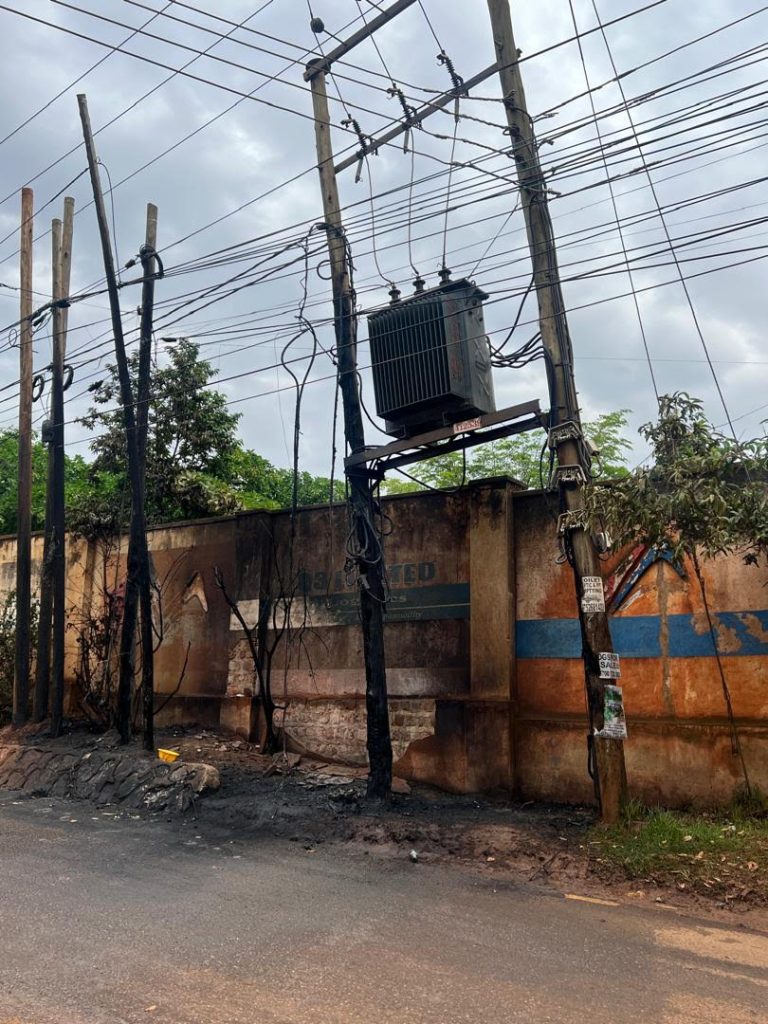
A distribution system consists of several components, including substations and switching stations, step down transformers, distribution lines or conductors, insulators, and electricity poles.
From a constraints perspective, transformers are the main bottleneck in power distribution. Globally, demand for transformers has increased due to the growth of data centers and gas turbine plants. Transformers are also responsible for a significant share of distribution losses. In Uganda, these losses are estimated at 17.3 percent.
Current lead times for transformers range from two and a half to three years. Switchgear lead times are around 30 to 32 months.
In a recent interview with the Daily Monitor, UEDCL Managing Director Paul Mwesigwa stated that it would take about two years to stabilize Uganda’s electricity distribution. I broadly agree with his assessment, as I independently arrived at a three year timeline. My conclusion assumes that all other factors remain constant, including government commitment to financing and efforts by the Ministry of Energy to shield UEDCL from competing business interests that may benefit from its failure.
One issue I had with the interview was the use of megawatts instead of megawatt hours. The true test of a system’s efficiency and reliability lies in how many megawatt hours it can distribute and sustain over time. A system may have an installed capacity of 1,115 megawatts, but still be unable to sustain that load reliably. That is the essence of Uganda’s distribution challenge.
Mwesigwa also highlighted some important figures. Uganda has about 3,500 overloaded transformer zones, with 600 of them critically damaged. UEDCL plans to inject 500 transformers by the end of 2026.
This is an ambitious target. Most of these transformers will be subject to government procurement processes, which often slow delivery. Lead times cannot simply be eliminated unless UEDCL pays premium prices for prioritization or compromises on quality by sourcing from lower cost suppliers, including some in India or China. These options involve trade offs.
Compromising on transformer quality increases the risk of higher losses, frequent failures, and even grid instability, especially if protection systems are inadequate. Poor quality equipment does not solve the problem, it merely postpones it through increased maintenance needs and failure rates.
Mwesigwa has indicated that UEDCL plans to source 2,500 transformers locally. This approach cuts both ways. Once production succeeds, the units must be deployed, and deployment itself requires planned shutdowns. At the same time, expanding and refurbishing the network stimulates additional demand for electricity.
This is similar to how building new roads does not always reduce traffic congestion. Instead, it often encourages more driving, eventually returning congestion to previous levels. Distribution upgrades create capacity, but they also induce new demand.
Cash flow is another critical issue. Mwesigwa has cited a requirement of about 950 million dollars to fund UEDCL’s five year strategic plan. For the first year, government approved only 74 million dollars. Financial structuring, however, is an area where Mwesigwa’s background as an economist, accountant, and MBA holder will be crucial.
In conclusion, UEDCL can stabilize Uganda’s power distribution network within three years, but only with exceptional commitment and operational excellence. It will require alignment across all power sector interests and deliberate protection of UEDCL from conflicting incentives.
The solution is not another UMEME. Uganda’s current position exists because UMEME managed the problem without fixing it. It dressed the wound instead of healing it. UEDCL now has the opportunity to do the harder work of healing. The road is long, but it is achievable.
Photo Credit: Marrion Apio