
By Ian Ortega
One of the most-poorly taught units at university was Material Science. As a Mechanical Engineering student, I felt ripped off. At the time, the only option was to scavenge Youtube, and textbooks to find a better approach. But that didn’t really help the case. When it came to Material Science, lecturers struggled to explain the Iron-Carbon diagram. When they would mention the phases, from austenites to the pearlites, nothing really drove the point home.
Now here I am, a decade later, and Artificial Intelligence happens, I go into ChatGPT and write a simple prompt; “I have 5 minutes for you to make me an expert in the Iron-Carbon Diagram, assume I am clueless…” And boom, it starts answering all the questions, why we even stop at 6.67% weight by percentage of carbon.
When this happened, a divine spark went through me. It hit me that we are on the cusp of something totally different. AI is really changing the world, but not in the way most people approach it.
I figure that currently people approach AI with maximum optimism (total adoption) or maximum pessimism (total avoidance). There are those who imagine a future where AI takes over everything and humans and everything about us is stolen or lost. Then there are those who are out to preserve everything human and ensure AI takes nothing from us.
Intersections Thinking
When I was younger, again, as a curious student at university, I chanced upon Steve Jobs and that became a life-defining experience. I must confess that I started to model myself around Steve Jobs. I watched and read everything Steve Jobs; I wanted to embody the Steve Jobs thinking. One of the outstanding bits was that Steve Jobs lived on the intersection of the sciences and the humanities.
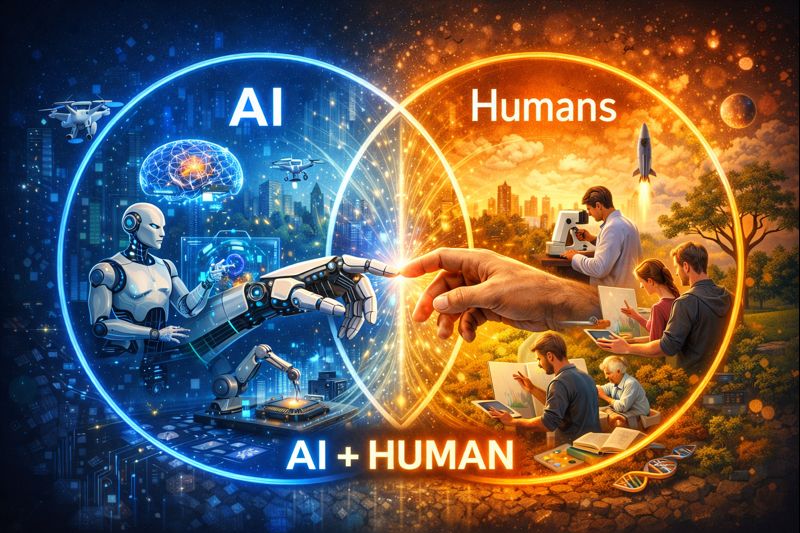
I take the same approach to AI and Humans. The real magic is going to happen at the intersection. As humans use AI to supercharge themselves, and as AI capitalizes on humans to even getter better. In the end, we are unlocking a future we cannot even imagine. This is not to deny the inherent risks with AI, but to show the approach that we should be taking.
It means, instead of teachers fearing that AI will take their jobs, AI will instead create a new version of teachers. Although we’ve watched dystopian movies about cyborgs, but I imagine that the future is going to trend towards cyborgs – the marriage of man and machine, the union of human and artificial intelligence. That union will produce an advantaged form of intelligence that will combat many problems that we’d failed to solve for in the past.